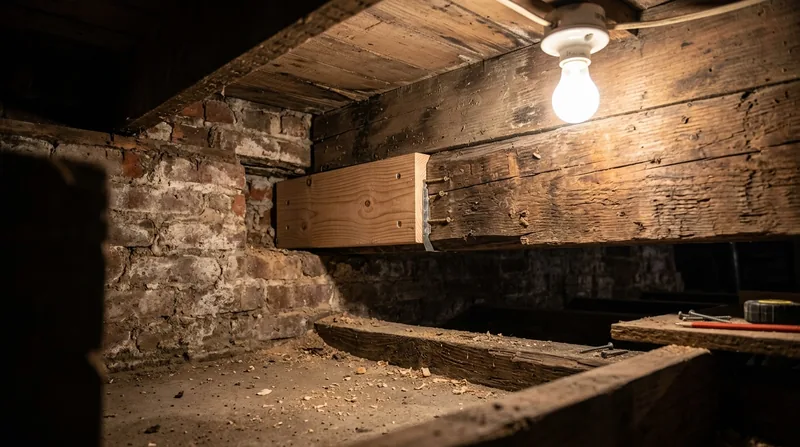




Sagging, bouncy, or soft floors in older Baltimore rowhouses and homes across the region usually trace to damaged floor joists or subfloor sections compromised by water exposure, wood rot, or structural settlement. The city's dense inventory of two- and three-story brick rowhouses, many built a century or more ago with original timber framing, sits on rolling terrain that steps toward the Inner Harbor, and the humid subtropical climate with nor'easters, occasional hurricane-remnant flooding near the harbor, and cold winters with icy snow creates persistent moisture stress on below-grade and rim-joist areas. Floor Joist and Subfloor Repair in Baltimore addresses these failures before they worsen, restoring structural integrity and floor levelness without unnecessary replacement. We sister compromised joists, rebuild subfloor sections, and level floors before finishes go back down. Our approach is repair-first: sound wood is reinforced, not torn out, and the same carpenters who diagnose the problem execute the fix. If you notice movement underfoot or soft spots in your floor, call us at (667) 239-7898 for a free, no-obligation estimate, or visit our contact page to request a site visit.
Why Floor Joist and Subfloor Damage Dominates in Baltimore's Older Housing Stock
Baltimore's residential foundation is built on century-old wood framing. The rowhouses of Fells Point, Canton, Locust Point, and East Baltimore, the elevated brick homes climbing Hampden and Woodberry above the Jones Falls, and the Arts and Crafts stone homes in Roland Park and Guilford all rest on timber sill plates, rim joists, and floor joists that are now 80 to 130 years old. Water intrusion from failed mortar joints, settled foundations, plumbing leaks, and chronic ground moisture is the dominant failure mode in this climate and building stock. When joists absorb water, they soften, sag, and lose load-bearing capacity. Subfloor sheathing, typically Douglas fir or similar softwood in older homes, delaminates and rots in place. The floor becomes noticeably uneven, springy, or soft underfoot. Left unaddressed, the structural degradation accelerates and repair costs rise sharply.
- Identify soft or spongy wood in joists and rim members before decay spreads to adjacent framing.
- Prevent further settlement and floor deflection by reinforcing or replacing compromised members early.
- Avoid costly full subfloor replacement by rebuilding only the damaged sections and sistering sound joists.
- Restore proper floor levelness so doors close without binding and finishes sit flat and true.
- Document repairs for insurance claims and future home sale transactions.
Early intervention saves money and protects the integrity of the framing above.
Baltimore building reality: The humid subtropical climate, nor'easters that drive rain sideways into rim joists and foundation walls, and the sheer age of the rowhouse stock mean that water damage to floor systems is endemic in this region. A soft floor in a Fells Point or Canton rowhouse is rarely cosmetic, it is structural.
For more information on related wood damage, see our Wood Rot and Dry Rot Repair page, which covers the broader pathology of which floor joist failure is a common expression.
How We Repair Floor Joists and Subfloor in Baltimore Homes
Our process begins with a detailed site inspection. We probe suspect joists and subfloor with a moisture meter and awl, map the extent of damage, and determine whether repair by sistering is sound or replacement is necessary. We then obtain any required permits from the Baltimore Department of Housing and Community Development (or the local building department in Towson, Dundalk, Essex, or other service areas) and execute the work systematically, jacking the floor level if needed, installing sister joists alongside compromised members, rebuilding subfloor sections with pressure-treated lumber or kiln-dried Douglas fir, and re-leveling before finishes are reinstalled.
- Inspect the entire affected floor zone, including rim joists, sill plates, and subfloor, using moisture testing and tactile probing to confirm the extent of rot or softness.
- Obtain building permits if required for structural repair or floor leveling work in your jurisdiction.
- Set temporary jacks and shoring to stabilize the floor and allow safe access for removal of damaged subfloor sections.
- Sister compromised joists by fastening new lumber alongside the existing member with bolts or lag screws at 16 inch centers, or replace the joist entirely if decay is too advanced.
- Rebuild subfloor sections using new pressure-treated or kiln-dried lumber, fastening to joists with ring-shank nails or screws to ensure a tight connection.
- Re-level the floor using hydraulic jacks, shimming joists and rim members until the surface is true to within 1/8 inch per 10 feet, a standard acceptable to most finish carpenters and flooring installers.
- Remove temporary shoring, inspect all fastening and connections, and prepare the subfloor for finish installation.
The entire process typically takes 3 to 7 days depending on the scope of damage and the complexity of access.
Real example: A Hampden rowhouse with a soft floor over the kitchen traced to a failed rim joist and water intrusion at the foundation line. We sistered the rim joist with a new pressure-treated member, rebuilt 60 square feet of subfloor, and re-leveled the kitchen floor. The repair cost less than half the price of a full subfloor replacement and the floor has remained solid for the three years since completion.
For structural framing challenges that require load calculations or engineered drawings, we work with licensed structural engineers and coordinate with the Baltimore building department. See our Beam Replacement and Load-Bearing Wall Removal page for details on that scope.
Repair Methods: Sistering vs. Full Replacement
| Approach | Description | Best for |
|---|---|---|
| Sistering | Fastening a new pressure-treated or kiln-dried joist alongside a compromised member with bolts or lag screws at 16 inch centers, preserving the original framing and doubling load capacity. | Joists with partial rot, moisture damage, or minor deflection where the wood is still sound enough to carry shared load with a sister member. |
| Full Joist Replacement | Removing a compromised joist entirely and installing a new member of the same species and dimension, using temporary jacks to support the floor during removal and installation. | Joists with advanced decay, significant deflection, or damage that extends more than 30 percent of the member length or width. |
| Subfloor Patching | Removing and replacing only the damaged section of subfloor sheathing, fastening new 3/4 inch plywood or tongue-and-groove lumber to existing joists with ring-shank nails or screws. | Localized rot or delamination affecting less than half the floor area, where joists beneath are sound and level. |
| Floor Re-leveling | Using hydraulic jacks and shims to bring a sagging floor back to true, often combined with sistering or joist repair to restore structural support and eliminate springiness. | Floors with settlement or deflection but sound underlying framing, or after joist repair to ensure finish installation is on a level surface. |
| Rim Joist and Sill Plate Repair | Sistering or replacing the rim joist and sill plate members that run around the perimeter of the floor system, critical to load transfer and moisture control at the foundation line. | Water intrusion at the foundation, failed mortar joints, or visible rot in the rim or sill, the most common failure point in Baltimore's older rowhouses. |
Sound wood is always reinforced or preserved when possible. Full replacement is recommended only when decay or damage is too advanced for repair to be reliable.
Floor Joist and Subfloor Repair Cost in Baltimore: What to Expect
Floor joist and subfloor repair in Baltimore typically starts at $1,800 for a small, localized repair affecting one or two joists and a limited subfloor section, with straightforward access and no complications. Most jobs in the $2,500 to $5,500 range involve sistering multiple joists, rebuilding 100 to 300 square feet of subfloor, and re-leveling a moderate-sized floor. Larger projects, such as extensive rim joist replacement, multiple damaged joists across a whole floor, or work requiring significant temporary shoring and jacking, run $6,000 to $12,000 or more. The primary cost drivers are the number of joists requiring repair or replacement, the extent of subfloor damage, the complexity of access (tight crawlspaces, finished ceilings below, or proximity to utilities), and whether the floor must be jacked and leveled. Travel is included in our pricing for Baltimore and surrounding service areas with no separate call-out fee.
The best way to understand the cost of your specific job is to request a free, no-obligation estimate. We respond within 24 hours at (667) 239-7898 and provide a detailed breakdown of labor, materials, and timeline before any work begins. For a fuller pricing overview and details on how we structure estimates, visit our pricing page.
Floor Joist and Subfloor Repair Near Me: What Baltimore Homeowners Should Know When Hiring a Carpenter
Finding a carpenter who understands the specific pathology of your floor damage, communicates clearly about repair versus replacement, and delivers reliable work is critical. The difference between a handyman franchise and a local carpentry shop is that we employ the same craftspeople who diagnose the problem and execute the repair, ensuring consistency and accountability. When evaluating a contractor, ask for evidence of insurance coverage (we are fully insured), request references from recent jobs, and get at least two or three written estimates so you can compare scope and price. Verify that the contractor understands local permit requirements, which vary by jurisdiction. In Baltimore proper, the Department of Housing and Community Development issues building permits; in Towson, Dundalk, Essex, Catonsville, Pikesville, Owings Mills, Reisterstown, Ellicott City, Columbia, Glen Burnie, Annapolis, Bel Air, Aberdeen, Westminster, Rosedale, Middle River, Randallstown, Perry Hall, and Parkville, check with the local building department or code office. Ask whether the work will require a permit for your specific project, and if so, confirm that the contractor will obtain it. If your home is in a historic district or subject to HOA restrictions, verify compliance with local design guidelines before work begins.
- Confirm that the contractor is fully insured and can provide a certificate of insurance on request.
- Ask for at least three references from jobs completed in the past two years, and call them to verify quality and timeliness.
- Request a detailed written estimate that itemizes labor, materials, timeline, and any assumptions about scope or site conditions.
- Verify permit requirements with your local building department before signing a contract, and confirm that the contractor will handle permitting or coordinate with a structural engineer if needed.
- Ask about the contractor's experience with your specific building type, age, and construction method, especially if your home is a rowhouse or has unusual framing.
A reputable local carpenter will answer these questions directly and provide a clear, honest assessment of whether your floor can be repaired or must be replaced.
To get started, contact us at (667) 239-7898 or fill out our online form for a free estimate. We serve Baltimore, Towson, Dundalk, Essex, Catonsville, Pikesville, Owings Mills, Reisterstown, Ellicott City, Columbia, Glen Burnie, Annapolis, Bel Air, Aberdeen, Westminster, Rosedale, Middle River, Randallstown, Perry Hall, and Parkville.
Floor Joist & Subfloor Repair in Baltimore: Pricing Guide
| Service | Price | Details |
|---|---|---|
| Small localized repair | Starting at $1,800 | One to two joists sistered or subfloor patching under 100 sq ft with straightforward access and no leveling |
| Moderate floor repair | Starting at $3,200 | Multiple joists sistered, 100 to 300 sq ft subfloor rebuilt, floor re-leveled, includes temporary shoring and standard access |
| Extensive joist and subfloor replacement | Starting at $6,500 | Full or partial joist replacement, rim joist repair, over 300 sq ft subfloor work, significant leveling, tight crawlspace or finished ceiling access |
| Complex structural or engineered repair | On estimate | Load-bearing alterations, multiple floor systems, structural engineer involvement, or permit coordination required for accurate pricing |
| Travel | Included | No separate call-out or mileage fee for Baltimore and surrounding service areas within our coverage zone |
| Estimate | Free | Response within 24 hours at (667) 239-7898, no obligation to book, detailed site assessment and written proposal included |
Indicative pricing, the exact cost depends on square footage, finish, and site access. Free personalized estimate within 24h at (667) 239-7898.


